Address
Building 1, Zone 1, Greenland Binhu International City, Zhengzhou, Henan, China
Work Hours
Monday to Friday: 9AM - 7PM
Weekend: 10AM - 6PM
Address
Building 1, Zone 1, Greenland Binhu International City, Zhengzhou, Henan, China
Work Hours
Monday to Friday: 9AM - 7PM
Weekend: 10AM - 6PM

When using corundum bricks in kilns, the core concerns are their thermal shock stability, construction details, and compatibility with the operating environment.
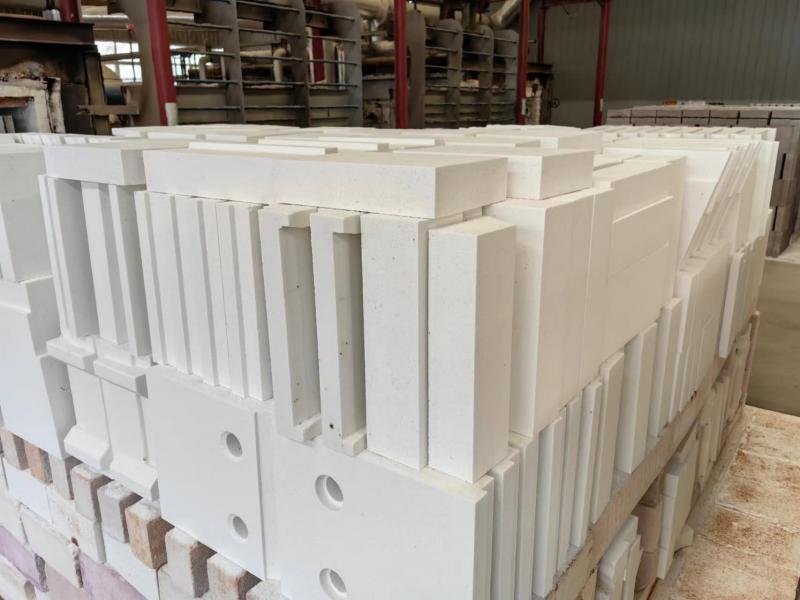
Corundum bricks have poor thermal shock stability and limited resistance to rapid temperature fluctuations. During kiln baking and operation, drastic temperature changes should be avoided, especially in the 900-1150℃ range. The heating or cooling rate should generally not exceed 15℃/h to prevent cracking or even shattering of the bricks due to crystal transformation. In areas with frequent temperature fluctuations (such as the charging port), it is recommended to use other brick materials for external protection.
The chemical compatibility between different refractory materials must be considered during construction. For example, fused cast zirconia corundum bricks and clay bricks may eutecticly fuse when in contact at temperatures above 1300℃; direct contact should be avoided during construction. Furthermore, for bricks with casting shrinkage cavities, the shrinkage cavities should be oriented towards the inside of the kiln when constructing the walls of the melting chamber to prevent material leakage due to erosion.
While corundum bricks have strong resistance to acid and alkali erosion, certain conditions still require attention. For example, fused zirconia corundum bricks produced under a reducing atmosphere have a higher carbon content, which significantly reduces their resistance to molten glass erosion, making them prone to contaminating the molten glass and generating bubbles. High-quality bricks produced by the oxidation method should be prioritized. Additionally, chromium corundum bricks with an appropriate amount of Cr₂O₃ exhibit superior performance in resisting slag penetration and chemical erosion compared to ordinary corundum bricks, making them suitable for more demanding conditions.
The choice of raw materials for corundum bricks directly affects their performance. Studies show that corundum bricks using tabular corundum as aggregate outperform similar products using fused white corundum as aggregate in terms of density, strength, wear resistance, and slag penetration resistance. Therefore, high-quality tabular corundum-based bricks should be given priority in key areas to achieve a longer service life.