Address
Building 1, Zone 1, Greenland Binhu International City, Zhengzhou, Henan, China
Work Hours
Monday to Friday: 9AM - 7PM
Weekend: 10AM - 6PM
Address
Building 1, Zone 1, Greenland Binhu International City, Zhengzhou, Henan, China
Work Hours
Monday to Friday: 9AM - 7PM
Weekend: 10AM - 6PM

The operating conditions of different parts of a new dry-process rotary kiln vary significantly. The refractory brick configuration follows the principle of “matching according to demand,” with a gradient layout from the kiln tail to the kiln head.
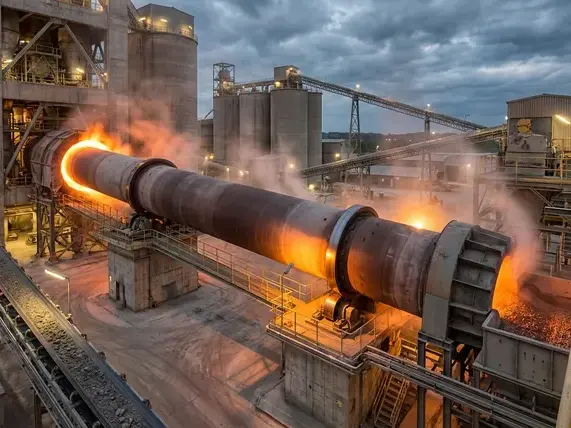
The rear section of the kiln shell and the preheating zone have lower temperatures (<600℃). The main challenge is alkali vapor condensation and erosion. Alkali-resistant clay bricks or heat-insulating alkali-resistant clay bricks are typically used, balancing alkali resistance and heat insulation.
The decomposition zone has temperatures of approximately 600-1000℃, primarily characterized by material abrasion and alkali erosion. High-alumina bricks (Al₂O₃ content >60%) or anti-sparging high-alumina bricks are standard, possessing good wear resistance and alkali resistance.
The transition zone (including the upper and lower transition zones) withstands severe temperature fluctuations of 800-1300℃, making thermal shock stability a key consideration. Magnesia-alumina spinel bricks or silica-mullite bricks are commonly used. Silica-mullite bricks (mainly composed of high-alumina bauxite and silicon carbide) exhibit outstanding thermal shock resistance and wear resistance, and do not adhere to kiln lining, effectively preventing ring formation.
The firing zone is the highest temperature area within the kiln (above 1450℃), subjected to intense chemical erosion and mechanical impact from the clinker melt. Traditionally, directly bonded magnesia-chrome bricks were the preferred choice, but the environmental risks associated with hexavalent chromium have prompted the industry to accelerate chromium-free substitution. Currently, magnesia-ferrometallic spinel bricks and periclase-composite spinel bricks are increasingly widely used, possessing excellent kiln lining adhesion and structural elasticity, forming a stable kiln lining protection.
The kiln opening (front and rear openings) withstands the erosion of high-temperature clinker and rapid thermal shock, resulting in a complex structure. Refractory castables are often used. For planned major overhauls, corundum-mullite castables can be used; for emergency repairs, rapidly solidifying phosphate castables are used. If the kiln opening is regular, silicon carbide bricks or silica-mullite bricks can also be selected.
Current material selection trends are clear: First, chromium-free materials are being fully replaced by spinel-based materials due to the environmental risks associated with hexavalent chromium in magnesia-chrome bricks. Second, energy conservation is being promoted, with composite bricks and lightweight designs gradually being adopted in transitional and decomposition zones.