Address
Building 1, Zone 1, Greenland Binhu International City, Zhengzhou, Henan, China
Work Hours
Monday to Friday: 9AM - 7PM
Weekend: 10AM - 6PM
Address
Building 1, Zone 1, Greenland Binhu International City, Zhengzhou, Henan, China
Work Hours
Monday to Friday: 9AM - 7PM
Weekend: 10AM - 6PM

The operating conditions of different parts of a vertical kiln vary significantly, and the selection of refractory bricks must consider thermal shock resistance, abrasion resistance, and chemical corrosion resistance. Based on existing technical data, the commonly used refractory brick configurations for each part are as follows:
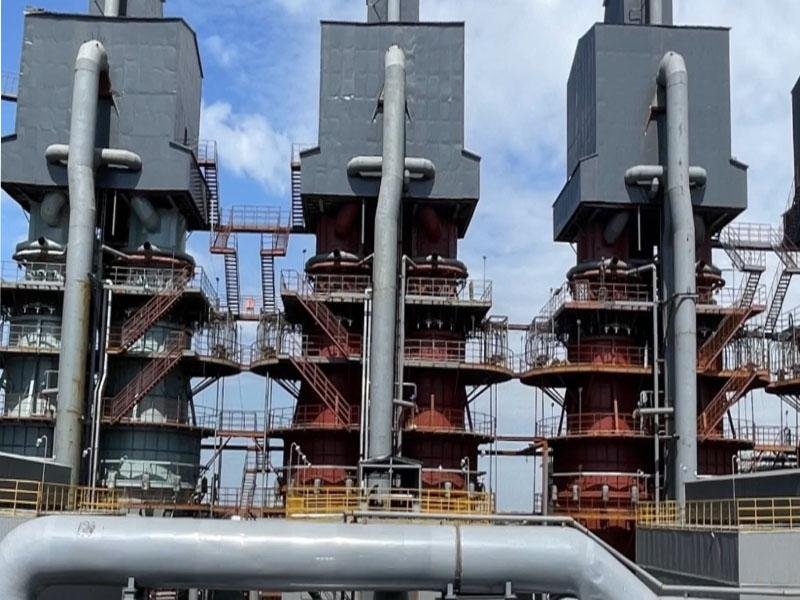
The flaking section is a critical area of the vertical kiln, needing to withstand high-temperature thermal shock and material abrasion. Silica-mullite bricks are commonly used as the working layer due to their outstanding erosion resistance and abrasion resistance. Some designs also use phosphate high-alumina bricks, utilizing their higher load softening temperature to extend the kiln lining life. Some designs employ a composite structure, where silica-mullite bricks provide erosion resistance, supplemented by clay bricks to reduce costs.
The high-temperature layer of the straight section (including the high-temperature zone and preheating zone) is usually surrounded by high-alumina bricks. In the preheating and high-temperature zones, phosphate-bonded high-alumina bricks are widely used due to their high strength, strong abrasion resistance, and good thermal shock resistance, enabling them to adapt to temperature fluctuations within the vertical kiln. For sections in contact with materials, to reduce “edge grinding,” phosphate-bonded high-alumina bricks or special high-alumina bricks with high alumina content are recommended.
The cooling zone experiences significant temperature fluctuations and is subjected to clinker grinding; therefore, material selection prioritizes wear resistance and thermal shock resistance. High-strength, dense clay bricks are recommended, ensuring both wear resistance and a certain level of thermal conductivity. Some technical solutions use high-alumina bricks as the inner lining working layer in this area.
The insulation layer does not directly contact high-temperature materials; its primary function is heat preservation and energy saving. Commonly used materials include lightweight insulating bricks, calcium silicate boards, aluminosilicate refractory fibers, or expanded perlite to reduce heat loss from the kiln surface.
In summary, the refractory brick configuration for vertical kilns exhibits a “zoning material selection” characteristic: the flared section prioritizes erosion resistance and thermal shock resistance; the straight-cylinder high-temperature zone prioritizes wear resistance and load softening temperature; the cooling zone prioritizes wear resistance; and the insulation layer primarily uses lightweight insulating materials. In actual selection, it is necessary to make comprehensive adjustments based on the specific kiln type, raw material characteristics, and operating procedures.