Address
Building 1, Zone 1, Greenland Binhu International City, Zhengzhou, Henan, China
Work Hours
Monday to Friday: 9AM - 7PM
Weekend: 10AM - 6PM
Address
Building 1, Zone 1, Greenland Binhu International City, Zhengzhou, Henan, China
Work Hours
Monday to Friday: 9AM - 7PM
Weekend: 10AM - 6PM

Aluminum bricks (usually referring to high-alumina bricks) are an indispensable refractory material in reverberatory furnaces. Due to their excellent high-temperature resistance, corrosion resistance, and thermal shock resistance, they are widely used in the construction of reverberatory furnaces in metallurgy, chemical industry, and other sectors. Their main applications focus on three aspects: furnace body protection, heat optimization, and operational condition adaptation, ensuring the stable and efficient operation of the reverberatory furnace.
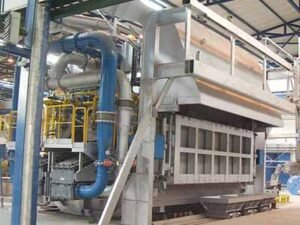
As the core protective material for the furnace body, aluminum bricks are mainly used to construct key parts of the reverberatory furnace, such as the furnace chamber, furnace roof, and furnace walls. The operating temperature of a reverberatory furnace is typically above 1000℃, and in some metallurgical smelting conditions, it can reach around 1700℃. Aluminum bricks have a refractoriness of 1750-1790℃, easily withstanding the high-temperature environment inside the furnace. Their high-load softening temperature can reach 1400-1600℃, allowing them to withstand the furnace body’s own load and the pressure of molten materials at high temperatures without easily softening or deforming, effectively maintaining the structural integrity of the furnace body. Meanwhile, aluminum bricks are nearly neutral, resisting the erosion of acidic and alkaline slags, reducing wear on the furnace lining from molten materials, and extending the furnace’s service life.
In terms of heat utilization optimization, aluminum bricks help improve the heat transfer efficiency of reverberatory furnaces. Reverberatory furnaces rely on the reflection and radiation of high-temperature gases to heat materials. Aluminum bricks, with their smooth surface and moderate thermal conductivity, reduce heat loss from the furnace body, providing insulation and energy saving. They also help reflect heat, ensuring uniform temperature distribution within the furnace and guaranteeing stable heating or smelting quality. Furthermore, the excellent thermal shock resistance of aluminum bricks can withstand the thermal stress caused by furnace start-up and shutdown, and temperature fluctuations, preventing lining cracking and spalling, reducing heat leakage, and further improving energy efficiency.
Aluminum bricks can be adapted to specific needs of different reverberatory furnace operating conditions. High-grade or specially formulated aluminum bricks are selected for areas with concentrated high temperatures and susceptible to impact from molten materials, such as furnace doors and burners, to enhance local protection. In reverberatory furnaces for copper, lead, and tin smelting in the metallurgical industry, areas in contact with molten metal are often constructed with aluminum bricks to meet the requirements of smelting conditions. In furnace lining sections that are not in contact with molten metal, aluminum bricks can be used in combination with lightweight refractory materials to achieve both insulation and protection, reducing production costs while ensuring furnace safety.
In summary, aluminum bricks, by strengthening the furnace’s protective barrier, optimizing heat utilization, and adapting to different operating conditions, have become crucial for the stable operation of reverberatory furnaces. Their application not only extends the furnace’s service life and reduces maintenance costs but also ensures production continuity and product quality, making them an indispensable core material for reverberatory furnaces operating under high-temperature and highly corrosive conditions.