Address
Building 1, Zone 1, Greenland Binhu International City, Zhengzhou, Henan, China
Work Hours
Monday to Friday: 9AM - 7PM
Weekend: 10AM - 6PM
Address
Building 1, Zone 1, Greenland Binhu International City, Zhengzhou, Henan, China
Work Hours
Monday to Friday: 9AM - 7PM
Weekend: 10AM - 6PM

Glass kilns are the core equipment in glass production, operating in extremely harsh environments, constantly at temperatures above 1600℃. They must also withstand the erosion of molten glass and alkaline vapors, as well as stress from temperature fluctuations. Therefore, the performance requirements for the refractory materials used in their construction are extremely high.
Silicon bricks, with their excellent high-temperature performance, good chemical stability, and economic viability, have become the preferred refractory material for glass kiln construction. They are widely used in key areas such as the kiln arch, breast wall, and neck.
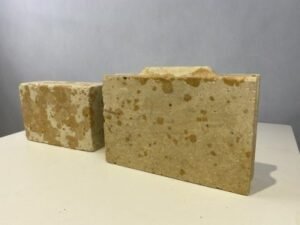
The core advantage of silicon bricks is their exceptional high-temperature resistance, perfectly suited to the high-temperature working environment of glass kilns.
During the glass melting process, the temperature of the molten section needs to be stable at around 1600℃, and even higher in some areas. This requires refractory materials to possess high refractoriness and good high-temperature structural stability. The main component of silica bricks is silicon dioxide (SiO₂), typically exceeding 95%, with high-quality silica bricks reaching as high as 99%, and their refractoriness reaching over 1710℃. With a softening temperature close to its refractoriness under load and a maximum service temperature of 1600-1650℃, silica bricks can maintain structural integrity for extended periods under the high-temperature conditions of glass furnaces, without softening or collapsing.
Simultaneously, silicon bricks undergo a crystal transformation at high temperatures, forming a stable cristobalite main crystalline phase. Their reheat linear shrinkage rate is controlled within +0.3%, exhibiting excellent volume stability. This effectively prevents cracking and disintegration of the bricks due to high-temperature expansion or contraction, ensuring the integrity of the furnace structure.
Silicon bricks possess excellent chemical stability, resisting the corrosive effects within the glass furnace without contaminating glass products.
Glass furnaces contain molten glass, alkaline vapors, and fly-off batch materials, which can cause strong chemical erosion and physical scouring of refractory materials. The main component of silica bricks, SiO₂, is consistent with the main components of glass. The reaction with molten glass at high temperatures is extremely slight; the corrosive substances will not contaminate the molten glass, ensuring the purity and quality of the glass products.
Furthermore, silicon bricks exhibit strong resistance to acidic furnace gases and molten glass. With a melt flow index controlled below 0.5, they effectively resist the erosion of alkaline vapors and fly-off materials, delaying brick damage and extending service life. Compared to other refractory materials, the alteration process of silica bricks at high temperatures primarily involves phase transformation and impurity migration, with minimal chemical erosion. They can also form a stable cristobalite surface through a “self-purification” process, further enhancing their erosion resistance.
Silicon bricks possess excellent thermal performance, improving the thermal efficiency of glass furnaces and reducing energy consumption.
Glass production is a high-energy-consuming industry, and the thermal efficiency of the furnace directly impacts production costs. Silica bricks have reasonable thermal conductivity, ensuring effective heat transfer within the furnace, resulting in a uniform and stable molten pool temperature, improving the homogenization effect of the molten glass, and reducing heat loss through the furnace body.
Honeycomb silica bricks, in particular, feature a pitted surface design that increases the radiative heat exchange area, enhances the dome’s heat storage capacity, and reduces molten pool temperature fluctuations. This approach not only improves glass quality but also reduces energy consumption.
Furthermore, the controlled apparent porosity of silicon bricks reduces heat transfer loss, further enhancing the thermal efficiency of the kiln and meeting the energy-saving requirements of glass production.
The economic efficiency and construction adaptability of silicon bricks meet the needs of large-scale glass kiln production.
Compared to high-end refractory materials such as fused zirconia-corundum bricks, silica bricks have a wider range of raw material sources. Using quartz sand as the main raw material, the preparation process is mature, resulting in lower production costs and significantly reducing the construction and maintenance costs of glass kilns.
Meanwhile, silicon bricks possess moderate mechanical strength, with a compressive strength exceeding 34 MPa. They exhibit excellent masonry performance, with tight joints, allowing for enhanced kiln integrity through staggered joint construction. They are also adaptable to the structural requirements of different parts of the glass kiln, providing excellent masonry results for areas such as the arch, breast wall, and neck.
Furthermore, the stable supply and complete range of specifications of silica bricks meet the construction needs of glass kilns of varying sizes, further enhancing their cost-effectiveness.
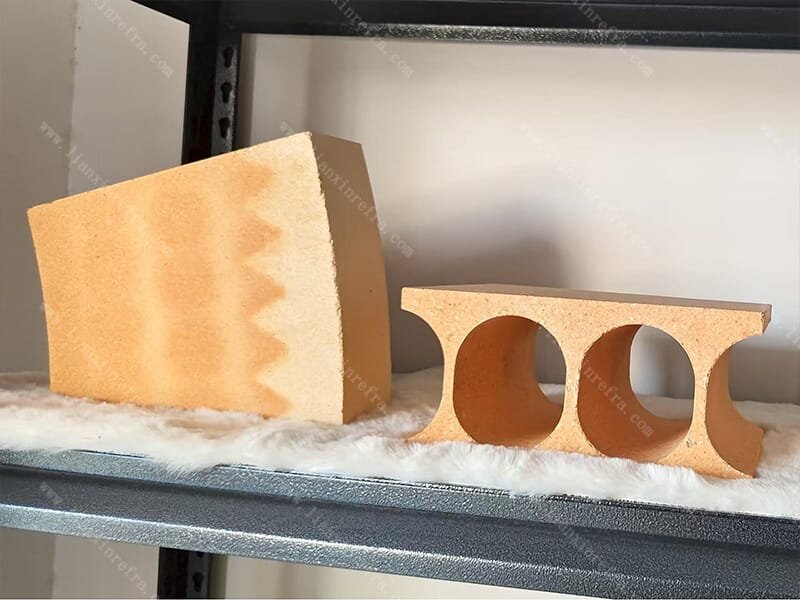
In summary, silicon bricks, with their excellent high-temperature resistance, good chemical stability, outstanding thermal efficiency, and economic advantages, perfectly meet the demanding operating requirements of glass kilns. They ensure long-term stable operation of the kiln, extend its service life, guarantee the quality of glass products, and reduce production costs. Therefore, they have become an indispensable core material in glass kiln construction and are widely used in the glass production industry.