Address
Building 1, Zone 1, Greenland Binhu International City, Zhengzhou, Henan, China
Work Hours
Monday to Friday: 9AM - 7PM
Weekend: 10AM - 6PM
Address
Building 1, Zone 1, Greenland Binhu International City, Zhengzhou, Henan, China
Work Hours
Monday to Friday: 9AM - 7PM
Weekend: 10AM - 6PM

Refractory bricks are the core lining material for ensuring the long-term stable operation of industrial kilns, controlling production costs, and mitigating safety risks. Their selection is not simply a matter of matching refractory temperature. It requires a comprehensive decision based on multiple dimensions, including kiln operating conditions, media characteristics, structural components, service life, and economic costs. It is crucial to avoid both wasteful refractory brick material selection due to over-selection and kiln malfunctions caused by insufficient performance. Only by establishing a scientific selection logic can the performance of refractory bricks be precisely matched to the needs of industrial production, laying a solid foundation for efficient kiln operation.

Accurately assessing kiln operating conditions and prioritizing core performance indicators is the prerequisite for selection. Operating condition parameters directly determine the core capabilities that refractory bricks must possess, with a focus on three key dimensions: temperature, media, and mechanical load.
Regarding temperature, it’s crucial to consider not only the normal operating temperature of the kiln but also the instantaneous maximum temperature and the frequency of temperature fluctuations. For conventional high-temperature kilns, the load softening temperature should be prioritized. This indicator directly reflects the structural stability of the material under the combined effects of high temperature and load. For equipment such as steelmaking converters and ladles, where operating temperatures often exceed 1600℃, high-grade products with a load softening temperature ≥1550℃ must be selected. In scenarios with frequent temperature fluctuations, such as glass kilns and intermittent ceramic kilns, thermal shock resistance becomes critical. Low-porosity high-alumina bricks and mullite bricks can withstand more than 25 cycles of water cooling at 1100℃, effectively resisting spalling damage caused by alternating hot and cold temperatures.
Regarding the media, the properties of the slag and gases in contact with the kiln must be clearly defined. For acidic slag environments (such as siliceous slag), silica bricks are preferred, as their silica content is ≥93%, exhibiting extremely strong resistance to acid erosion. For alkaline slag environments (such as calcium-magnesium slag in steelmaking and cement production), magnesia-chrome bricks and dolomite bricks are suitable. These bricks, with magnesium oxide as their core component, exhibit outstanding resistance to alkaline media. If exposed to sulfur- or chlorine-containing corrosive gases, corundum or carbon composite refractory bricks with strong erosion resistance must be selected.
In terms of mechanical load, parts subjected to material impact and kiln rotation friction must balance room temperature compressive strength and abrasion resistance to prevent brick breakage and detachment.
Based on chemical composition classification, rationally matching the material characteristics of refractory bricks is the core step in selection. Different refractory brick materials have significantly different performance characteristics, requiring targeted selection based on specific operating conditions.
Acidic refractory bricks are primarily composed of silica, exhibiting good high-temperature volume stability and high thermal conductivity. Besides resisting acidic slag erosion, they are suitable for high-temperature firing environments and are widely used in coke oven carbonization chambers, glass melting furnace regenerators, and acidic open-hearth steelmaking furnaces. However, their resistance to alkaline erosion is extremely poor, and they are strictly prohibited from use in alkaline conditions.
Neutral refractory bricks offer balanced performance and the widest range of applications. High-alumina bricks (alumina content 48%-75%) offer excellent cost-effectiveness, combining thermal shock resistance and erosion resistance, making them the preferred choice for ceramic kilns, tunnel kilns, and hot blast stoves. Corundum bricks (alumina content ≥90%) possess outstanding high-temperature strength and wear resistance, making them suitable for critical areas such as the high-temperature core zone and nozzles of kilns. Carbon bricks and carbon composite bricks exhibit extremely strong thermal shock and slag resistance, along with good thermal conductivity, making them the core lining material for blast furnace hearths and bottoms. However, care must be taken to prevent high-temperature oxidation.
Alkaline refractory bricks, primarily composed of magnesia and calcium oxide, exhibit significantly higher resistance to alkaline slag and iron slag than other materials. Magnesia-chrome bricks, in particular, demonstrate good stability and are used in steelmaking converters and ladle linings. Dolomite bricks offer even stronger alkali resistance but are prone to hydration and have poor thermal shock stability, requiring storage and use in a dry environment. They are suitable for applications such as cement rotary kiln firing zones and alkaline steelmaking furnaces.

Differentiated refractory brick selection based on the kiln’s structural components is crucial for extending its lifespan. Different parts of the kiln operate under significantly different conditions, necessitating targeted selection of refractory bricks to avoid a “one-size-fits-all” approach.
The high-temperature core zone, such as the combustion chamber and firing zone, experiences the highest temperatures and most severe corrosion. High-end products with high temperature resistance, corrosion resistance, and dense structure are required, such as silicon corundum bricks and magnesium aluminate spinel bricks. These bricks can maintain structural stability at temperatures above 1600℃, resisting the dual corrosion of molten slag and high-temperature gases.
The preheating zone and transition zone have large temperature gradients and frequent hot and cold cycles, and there is no severe mechanical impact. Phosphate-bonded high-alumina bricks and mullite composite bricks are suitable. These bricks balance thermal shock stability and mechanical strength, can adapt to temperature fluctuations, and are relatively cost-effective.
The cooling zone has lower temperatures, but is subject to severe wear due to material impact and airflow friction. Products with high wear resistance and anti-stripping properties are required, such as silicon carbide bricks and steel fiber reinforced high-alumina castables. Silicon carbide bricks have more than five times the room-temperature wear resistance of ordinary high-alumina bricks, effectively reducing wear and tear.
The insulation layer needs to balance insulation performance and structural support. Lightweight refractory bricks such as lightweight clay bricks and diatomaceous earth bricks are recommended. These bricks have low thermal conductivity (≤0.8W/(m·K)), significantly reducing heat loss from the kiln. Their light weight also reduces the structural load on the kiln. However, it’s important to note that lightweight bricks have relatively low strength and cannot be used in load-bearing or high-temperature core areas.
Considering the entire life cycle cost and effectively controlling procurement, storage, and construction are crucial for successful material selection. Selection should not solely rely on the initial purchase refractory bricks price; the entire life cycle cost must be calculated. For example, while silicon carbide bricks are 8-10 times more expensive than ordinary clay bricks, their service life is 3-5 times longer. And they reduce kiln downtime for maintenance, resulting in lower long-term overall costs. For intermittent small kilns where service life requirements are not high, cost-effective clay bricks or ordinary high-alumina bricks are sufficient. There’s no need to blindly pursue high-end materials. Strict quality control is essential during procurement. Verify that products comply with ISO 9001 quality system certification and national standards (such as GB/T 3994-2014), request third-party testing reports, and focus on key indicators such as apparent porosity (generally controlled below 18%), room temperature compressive strength (≥30MPa), and thermal shock stability to avoid purchasing inferior products.
Storage and construction are equally critical. Magnesia-based and dolomite-based alkaline refractory bricks must be stored in a dry, well-ventilated place, strictly preventing moisture absorption and hydration. During transportation, take precautions to avoid mechanical collisions that could damage edges and corners. During construction, ensure uniform mortar joints (≤2mm), select suitable refractory mortar, and bake high-temperature areas to prevent cracking due to sudden temperature increases.
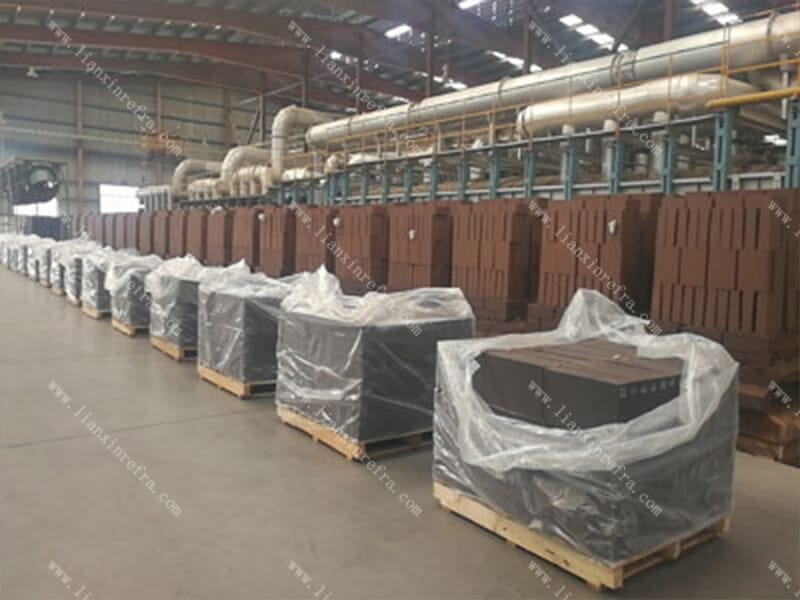
In summary, the correct selection of refractory bricks for industrial kilns must follow a complete logical chain of “operating condition analysis—material matching—location adaptation—cost accounting,” while also considering details throughout the entire process of procurement, storage, and construction. Scientific selection can not only extend the service life of kilns by more than 30%, but also reduce energy consumption and maintenance costs by 10%-15%, effectively avoiding production interruptions and safety risks caused by brick breakage. In actual selection, kiln type, production process and industry cases can be considered, and professional technicians can be consulted when necessary to achieve the optimal match between refractory bricks and industrial kilns.
As one of top refractory brick suppliers in China, Henan Ruitai Lianxin Refractory Materials Co., Ltd is a modern R&D-centered refractory manufacturer manufacturing enterprise integrated with refractories sales and marketing, furnace engineering construction, recycling and sales of waste refractories as well as refractory raw material, technology and goods import and export, and technical services. If you have any needs for refractory materials and purchase refractory bricks, please contact us and we will provide you with the best service.